


The XPENG L03: Inside the Brand Vision Powering the World's Fastest-Growing AI Car Company
The XPENG L03 is XPENG's newest AI SUV — and, for the brand, perhaps the most important one yet. For most car companies, a new SUV launch is a product story: another electric crossover, another set of specifications, another dealer appointment booked. For XPENG, the L03 is something else entirely. It is a public statement of intent — a tangible answer to the question the company has spent the last decade quietly building toward: what happens when a car company treats artificial intelligence not as a feature, but as the foundation?
That answer is the L03 itself — and the technology inside it.
A vision called "Physical AI for All"
Back in July, on a stage in Munich, XPENG framed the L03 around a single phrase: "Physical AI for All." It is more than a marketing line. It is the brand's organising principle — the idea that the same AI which can drive a car, animate a humanoid robot, or pilot a flying vehicle, should not be locked away in ultra-premium flagships. It should be available to the person buying their first new SUV.
For a company that has now sold more than 1.2 million vehicles across 65 countries, that principle has not come cheaply. XPENG runs its own AI research team in Guangzhou and Beijing, builds its own Turing AI chips, develops its own in-cabin operating system , and maintains an in-house second-generation VLA model — Vision-Language-Action, the AI architecture that allows a car to understand the physical world the way a human driver does, rather than merely react to mapped corridors (This feature may not be available in some countries and vehicle models due to development schedules and local regulations). None of that is sourced from a Tier 1 supplier. None of it is a paid-for badge.
The L03 is the first model in which those building blocks genuinely come together in a mainstream price segment — one that the rest of the industry reserves for stripped-back, spec-sheet minimalism. XPENG's bet is that AI capability is about to follow electric range down the same adoption curve. The brand that owns that moment will own the next decade of the car business.
Built for every market from day one
The L03 is not a Chinese-market car that has been retrofitted for export. It is the first XPENG model developed simultaneously for 65 markets from day one — design, engineering, software and homologation all running in parallel, not sequentially. That distinction matters to anyone who has ever watched an "international model" turn out to be a Chinese specification sheet with translation errors.
The same body, the same battery architecture, the same driver-assistance stack was certified, tested and signed off against three of the world's strictest safety regimes in parallel — a multi-jurisdiction process that almost no competitor in this segment even attempts.
That multi-market engineering discipline is exactly why XPENG's global safety story is credible: the same body, the same battery architecture and the same driver-assistance stack are validated against three of the world's strictest regimes at once — not bolted on for one market afterwards.
Design that says something about the brand
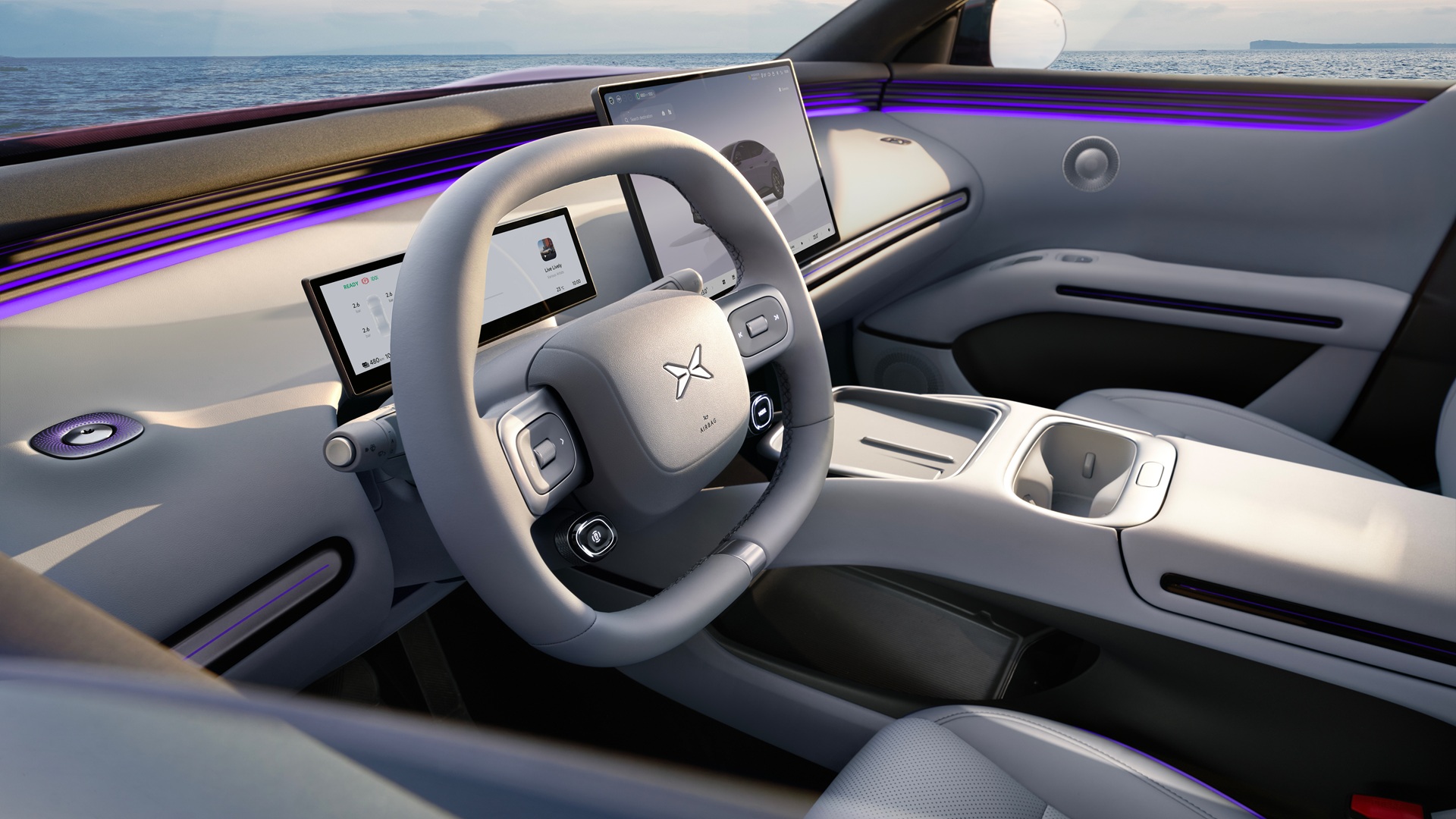
A brand vision is only credible if the product that embodies it is desirable in its own right. The L03's design was led by JuanMa Lopez, XPENG's Design Vice President and former Ferrari exterior design lead, working with a team of designers from 23 countries under the studio banner "Vital Flow" (the flowing vitality of life).
The styling language translates that philosophy into measurable terms:
A coupé roofline with a Cd 0.228 drag coefficient — among the lowest in any production SUV globally, and the direct result of 22 individual aerodynamic optimisations across the body
A 0.46 wheel-to-height ratio and 1.20 width-to-height ratio that read as "wide, low, ready"
Semi-flush door handles, frameless doors, a concealed water cut — the design vocabulary of a premium European GT, applied to a compact family SUV
This is not retro-brand design — XPENG, founded in 2014, has no heritage to lean on. It is forward-brand design: every surface is doing work, every ratio is a calculation. The visual signature signals that this is a company building a design language from scratch — and confident enough to expect you to recognise it on the road.
Turing AI: 1,500 TOPS in the compact SUV segment
The clearest expression of "Physical AI for All" is computational. The L03 brings 1,500 TOPS of effective on-board compute to the compact SUV segment — a figure that, two years ago, would have been reserved for vehicles twice the price. XPENG achieves this through its in-house Turing AI chip: the L03's Ultra variants run two Turing chips in tandem as standard. The second-generation VLA model — covering both City NGP and Highway NGP — is planned to arrive via over-the-air upgrade in early 2027.
What does 1,500 TOPS buy a driver in practice? It buys an AI driver-assistance stack that does not collapse the moment it leaves a mapped corridor. It buys lane changes in unstructured traffic, smoother negotiation of unsignalised intersections, better anticipation of the unusual. In 2026, that kind of capability is still mostly reserved for vehicles far further up the price ladder — and the L03 is what happens when a company decides to start that conversation at a mainstream price instead.
And because the underlying VLA model is one architecture, not a regional patchwork, the L03 is the same car whether it is driven in Germany, France, China or any of the other 65 markets the platform was engineered for — the same model, refining itself across some of the most demanding driving environments on earth, simultaneously.
What the L03 says about XPENG
The L03 is XPENG's first compact SUV positioned as a "Next-Gen AI SUV Coupe" — and the first XPENG model to bring the full Turing AI stack together in this segment, on the Ultra variants, as standard equipment.
The L03 is not the end of the story — it is the most visible expression of a much longer roadmap. To learn more about the model, visit the official XPENG L03 page.
The bigger picture: a brand building an AI ecosystem, not just cars
The L03 is a car, but XPENG is no longer just a car company — it is a physical AI company with three product lines sharing one technology base:
AI cars — the L03 and its siblings, the G6, G9, P7, P7+ and X9, all running on the Turing stack
Humanoid robots — with mass production of high-end humanoid models targeted from late 2026
Flying cars — 7,000+ pre-orders already taken, with the world's first planned 10,000-unit-per-year modular flying car factory that completed its mass-production trial run in late 2025
The L03 is the most visible expression of that ecosystem available today. The robotaxi pilots running in China, the humanoid prototypes walking through factory floors, the flying vehicle programme that has been quietly booking orders — all of it shares the same AI backbone that will be guiding your L03 through city traffic. For a brand pitching itself as "the brand of physical AI", that integration is not a tagline. It is the most strategically interesting thing about the L03 — and the reason a brand-conscious buyer should care about more than the spec sheet.
A landmark moment
The XPENG L03 is one of the more quietly significant product launches of 2026. It is the moment a serious global contender — backed by in-house AI silicon, in-house operating systems, and a body of safety validation across three continents — commits to bringing its full technology stack to the compact SUV segment at a mainstream price. That matters because it signals where the industry is heading: AI capability following electric range down the same adoption curve, and a brand choosing to start the price conversation at a mainstream price point rather than the premium end of the market.
The L03 is not just another SUV. It is the moment a brand tells you, publicly and irreversibly, where it intends to be standing in 2030. Every market that gets the L03 — present or future — will be watching the same bet play out.
Disclaimer
Unless otherwise stated, all data displayed on this page are sourced from XPENG laboratory testing and are provided for reference only. Actual performance may vary depending on the specific vehicle configuration, vehicle condition, and other factors. Actual results may vary under real-world conditions.
Specifications, range figures, compute figures (1,500 TOPS) and safety ratings referenced in this article reflect information available at the time of publication. Final market specifications, regional safety rating status, drive-away pricing and standard equipment for the XPENG L03 are subject to confirmation by XPENG. Please refer to https://www.xpeng.com/au/model/L03 for the latest official product information.
"Physical AI for All" is XPENG's stated global brand vision as communicated at the XPENG LIVE Munich event in July 2026. It is not a product warranty or capability guarantee.
Turing AI, VLA-2, XOS 6, Vital Flow and JuanMa Lopez references are used in their trade-mark / official attribution sense to describe XPENG's technology and design programmes; they do not imply partnership endorsement.
ANCAP, Euro NCAP and China C-NCAP five-star references reflect XPENG's stated engineering target for the L03 platform. Regional rating publication timing should be confirmed via each programme's official site.
Any forward-looking statements about humanoid robots (scaled mass production targeted from late 2026), flying car volumes, or charging-network rollouts are based on publicly stated company programmes and remain subject to change.
This article is editorial commentary produced by XPENG for brand vision communication purposes — to illustrate how the L03 reflects the company's R&D capabilities, technology stack and "Physical AI for All" vision. It is not financial advice, not a recommendation to purchase, and not a substitute for the official XPENG product disclosure materials.
Images are illustrative; final vehicle appearance, colour availability and interior configurations for each market will be defined in the official local specification release.


